

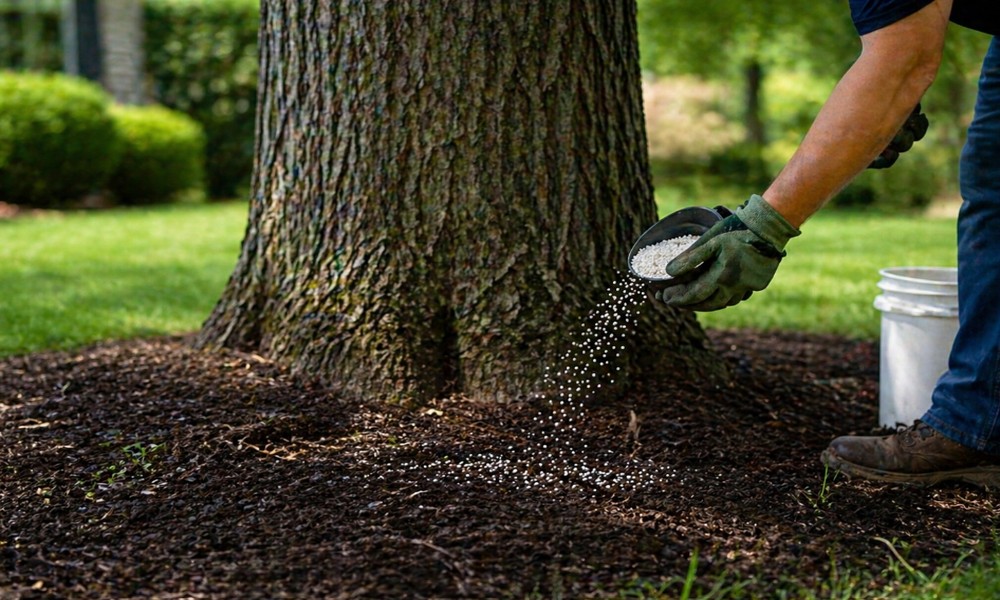
Trees look strong from the outside. A mature tree can stand tall through heat, rain, wind, and changing seasons. But even strong trees need the right support below the ground. As an arborist, I often remind homeowners that tree health starts with the soil first, not the branches.
That is where tree fertilization comes in.
Tree fertilization helps provide nutrients that may be missing from the soil. It supports root growth, leaf production, disease resistance, and overall tree strength. It is not a magic fix for every problem. I wish it were that easy. But when done correctly, fertilization can play a big role in keeping trees healthy for many years.
What Is Tree Fertilization?
Tree fertilization is the process of adding nutrients to the soil so the tree can absorb them through its roots. These nutrients help the tree grow, repair itself, and handle stress.
The main nutrients trees usually need are nitrogen, phosphorus, and potassium. You may see these listed on fertilizer bags as N-P-K. Nitrogen helps with leaf and shoot growth. Phosphorus supports root development. Potassium helps with overall strength, water movement, and stress tolerance.
Trees also need smaller amounts of nutrients like iron, magnesium, calcium, and manganese. These are called micronutrients. They may be needed in smaller amounts, but they still matter.
A tree growing in a forest often gets nutrients naturally. Leaves fall, break down, and return organic matter to the soil. In a yard, things are different. Leaves are often raked away. Grass competes with tree roots. Soil may be compacted. Construction, foot traffic, and irrigation changes can also affect the root zone.
So, the tree may not be getting the same natural support it would receive in a healthy woodland setting.
Why Fertilization Matters for Long-Term Tree Health
Tree fertilization helps support the tree over time. Not just for one season, but for many growing cycles.
A tree with enough nutrients can usually produce stronger leaves, grow better roots, and recover more easily from stress. Healthy trees are also often better at defending themselves against pests, disease, drought, and weather damage.
Think of it like this. A tree under stress is already using energy just to survive. If the soil is poor, the tree has fewer resources to repair damage or fight off problems. Fertilization can help refill some of those missing resources.
But again, fertilization must be done correctly. Too much fertilizer can harm roots, cause weak growth, or create more problems than it solves.
Signs A Tree May Need Fertilization
Not every tree needs fertilizer. Some trees are doing just fine. Others show signs that the soil may not be giving them enough support.
Common signs include:
- Pale or yellowing leaves
- Smaller leaves than normal
- Slow growth
- Thin canopy
- Early leaf drop
- Dead twigs near the branch tips
- Poor flowering or fruiting
- Weak-looking new growth
- General decline without a clear cause
These signs do not always mean a tree needs fertilizer. They can also point to root damage, pests, disease, drought, poor drainage, or compacted soil. That is why inspection matters.
As an arborist, I do not like guessing with fertilizer. Soil testing and tree assessment can help show what the tree actually needs.
The Importance of Soil Testing
Soil testing is one of the best first steps before fertilizing a tree. It can show nutrient levels, soil pH, and other conditions that affect how well the tree can absorb nutrients.
Soil pH is especially important. If the pH is too high or too low, nutrients may be present in the soil but unavailable to the tree. That means adding more fertilizer may not solve the problem.
For example, some trees show yellow leaves because they cannot absorb iron properly. Adding a general fertilizer may not help much if the real issue is soil pH.
A soil test helps avoid wasted effort. It also helps prevent over-fertilizing, which can damage the tree and the surrounding landscape.
How Fertilization Supports Root Growth
Roots are the foundation of tree health. A tree can only be as strong as the root system supporting it.
Good fertilization can encourage root development, especially when the tree is growing in poor or disturbed soil. Strong roots help the tree absorb water, take in nutrients, and stay stable during storms.
This is important for young trees, but it also matters for mature trees. Older trees may have large root systems, but those roots can be stressed by compacted soil, nearby construction, lawn competition, or changes in moisture.
When fertilization is paired with proper mulching, watering, and soil care, the root zone can become healthier over time.
Fertilization And Stress Recovery
Trees deal with stress all the time. Drought, storms, pruning wounds, transplant shock, soil compaction, and pest activity can all weaken a tree.
Fertilization may help a stressed tree recover, but only if nutrients are part of the problem. This is where people sometimes make a mistake. They see a struggling tree and immediately add fertilizer. But if the tree is stressed because of too much water, root rot, or severe pest damage, fertilizer may not fix it.
In some cases, fertilizing a severely stressed tree can even make things worse by pushing new growth when the tree does not have enough energy to support it.
So the best approach is careful. First, find the cause of stress. Then decide if fertilization belongs in the care plan.
Different Ways Trees Are Fertilized
Tree fertilization can be done in several ways. The right method depends on the tree, soil, location, and goal.
Surface fertilization is applied on top of the soil, usually across the root zone. This can work well when conditions are right.
Deep root fertilization places nutrients below the soil surface, closer to the active root area. This can be useful in compacted or turf-covered landscapes.
Organic soil amendments, like compost, can improve soil structure and add nutrients slowly. These can be helpful when the goal is long-term soil improvement.
Slow-release fertilizers are often preferred for trees because they feed gradually. Fast-release fertilizers can push quick growth, but that is not always what a tree needs.
Why More Fertilizer Is Not Always Better
This part matters. More fertilizer does not mean better tree health.
Too much fertilizer can burn roots, increase salt levels in the soil, cause weak branch growth, and make the tree more attractive to some pests. It can also run off into nearby waterways.
A good fertilization plan should match the tree’s needs. The goal is steady support, not forced growth.
I usually think of fertilization as one part of tree care. It works best with proper watering, mulch, pruning, pest monitoring, and root protection.
Final Thoughts
Tree fertilization plays an important role in long-term tree health when it is used correctly. It can support stronger roots, better leaf growth, improved stress recovery, and better overall tree strength.
But fertilizer is not a cure-all. The tree’s condition, soil quality, moisture level, and root health all need to be considered first.
A healthy tree starts with healthy soil. When the soil has the right balance of nutrients, air, moisture, and organic matter, the tree has a much better chance of thriving for years. And honestly, that is the real goal. Not fast growth. Not a perfect-looking tree overnight. Just steady, healthy growth that lasts.
This post was written by a professional arborist at Tree Removal Clearwater FL. Robert Miller is the owner of Arbor Wise Professional Tree Care, a locally owned and operated tree service company that offers superb lawn care by the most experienced Arborists. Arborwise Tree Services is a tree removal company that offers stump removal, tree pruning, stump grinding, fertilization, and tree restoration. We have an extraordinary lawn care industry notoriety covering the Pinellas county area.
