

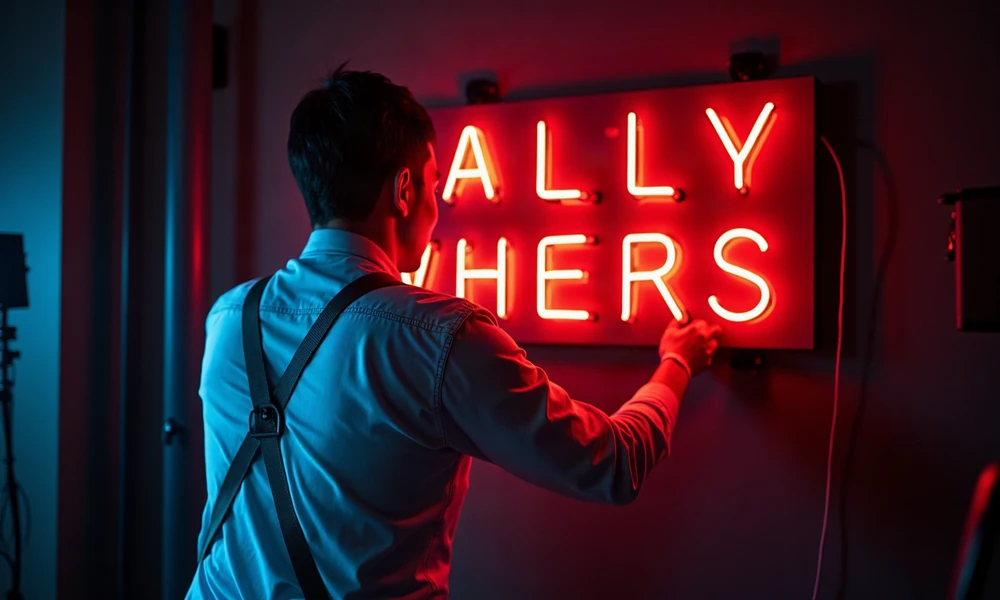
Mounting illuminated signage onto a stage set introduces a set of problems that neither a standalone neon piece nor a plain backdrop presents on its own. The sign has weight the set was not necessarily designed to carry, it needs power routed through a structure built for appearance rather than services, and it has to stay secure through a build, a rehearsal, and a live programme with people moving around and behind it. Four factors determine whether an illuminated element integrates cleanly into an event backdrop in Singapore or becomes the thing the crew is still working on an hour before doors.
1. Weight and Where the Backdrop Structure Can Actually Take It
Acrylic-backed signage is heavier than people estimate, particularly at larger sizes, and the load is distributed across a small number of mounting points rather than spread evenly across the panel.
Stage flats, fabric-covered frames, and modular panels vary considerably in what they can support and where. Mounting into a panel face rather than into the frame behind it is a common error that holds through a build and fails under vibration or a knock during the event.
Establish the sign’s finished weight early, identify the structural members behind the visible surface, and plan mounting points to coincide with them. Where the backdrop cannot take the load, the sign needs independent support behind it rather than additional fixings into material that was never going to hold.
2. Power Supply, Distribution, and Where the Driver Sits
Illuminated signage needs a supply, and the practical questions are where it comes from, how it reaches the sign, and where the driver or transformer is located.
Drivers generate heat and need ventilation, which means they cannot simply be tucked into a sealed cavity behind a panel. They also need to be reachable if something fails during the event, and a driver mounted where nobody can get to it without dismantling the set is a problem waiting for a bad moment. Anyone installing neon signage in Singapore onto a stage structure should confirm the total load, how it is distributed across circuits, and whether the venue supply in that position can carry it alongside everything else drawing from the same source.
Electrical work should be carried out by appropriately qualified people with documentation, since venues ask and inspections look for it.
3. Cable Routing That Stays Invisible and Out of the Way
Cables have to run from the supply to the sign without appearing in sightlines, crossing walkways, or sitting where crew move during a programme.
Plan the route at design stage rather than solving it during build, when the options narrow to taping cable somewhere visible. Routing behind the backdrop is usually preferable, which requires access points designed in rather than cut later.
Secure fixing matters as much as concealment, since a cable that works loose during a live event is both a hazard and a visible failure.
4. Access for Testing, Adjustment, and Fault Response
Something will need adjusting: a section not lighting, a connection working loose, a driver requiring a reset. The time to establish how someone reaches it is before the set is fully assembled.
Build in access from behind, keep connections reachable, and test the complete assembly before the set is closed up rather than after. A sign that works on a workshop bench and fails once installed is a familiar scenario, and the difference is usually a connection disturbed during mounting.
Resolving These at Design Stage Rather Than During Build
Almost everything above is cheap to address on a drawing and expensive to address on site with a programme approaching. The useful step is a conversation between whoever is fabricating the sign and whoever is building the set, before either is finalised.
That conversation should cover finished weight, mounting point locations, driver position, power requirement, cable route, and access provision. Where those two parties are different suppliers, someone on the client side usually has to initiate it, since neither will necessarily think to ask the other without prompting.
Contact Sui Generis Neon to coordinate signage fabrication with your stage build and resolve mounting and power requirements early.
